After the warmest summer on record, waiting on net zero isn’t an option
02 November 2026 Category: ESG How Nviro colleagues support clients
Summer 2026 was the UK’s warmest on record, and its effects are still showing up in schools, colleges and council buildings. Here’s an honest look at what it left behind, where a cleaning contract’s carbon really comes from, and how we help you cut carbon and water without cleaning less.
For fifty years, 1976 was the summer every hot British summer was measured against. The long heat, the exceptional sunshine and the drought earned it a place in the national memory. Half a century on, 2026 has rewritten the record books. The Met Office has confirmed summer 2026 as the UK’s warmest summer on record. The mean temperature was 16.5°C (1.9°C above the long-term average), Kew Gardens hit 38.1°C on 13 August, and 54 weather stations broke their all-time daily records. 1976 now sits seventh on the list.
The clocks have gone back and half term has come and gone, but if you look after a school, college or council building, the summer isn’t over yet. It was hot exam halls in June and July. Dusty corridors. Watering restrictions. Six weeks of buildings standing open to the weather while everyone was away, and a lot of difficult calls about which windows to open, and when. Some of what it left behind is still showing up now.
It has changed the conversation about net zero, too. Carbon reduction is no longer something to plan for someday. Your colleagues, students, visitors and governors are asking about it this term. Cleaning sits closer to the centre of that picture than most people expect. So here is an honest look at where it sits, and what we can do about it.
Your cleaning contract is part of your carbon footprint
When your organisation reports its emissions, the ones you produce directly are only part of the total. A large share comes from the goods and services you buy, and that includes the cleaning of your buildings. Your cleaning contract sits within your Scope 3 emissions, under purchased goods and services.
That matters for a practical reason. If you are working towards a net zero target, writing a climate action plan, or answering questions from stakeholders or auditors, you need data from your suppliers. Good intentions aren’t enough. You need data on what is actually being done. With year-end reporting and the tender cycle now well under way, those numbers are usually needed sooner than people expect.
It’s worth being clear about where a cleaning contract’s carbon actually comes from, because it is rarely where people assume. Very little of it is the cleaning itself. We know this from our own numbers. Working with carbon consultancy Neutral Carbon Zone, we measured our full Scope 1, 2 and 3 footprint for 2024/25 at 1,508.54 tonnes of CO2e, and that is now the baseline we measure our reductions against.
Three areas make up over 80% of it:
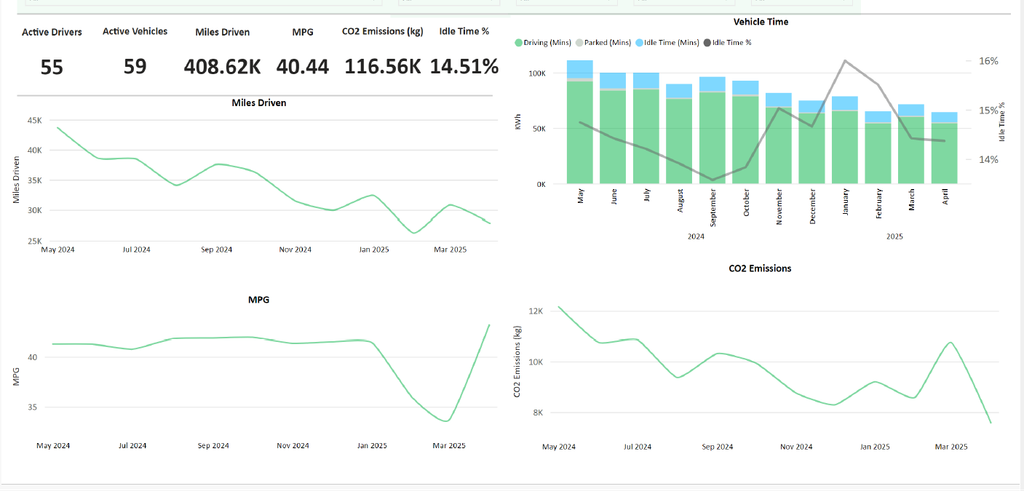
- Our fleet: Our area cleaning managers drove over 400,000 miles in 2024/25, visiting sites and delivering supplies.
- Travel: Colleagues getting to site is our largest single source of emissions, so we schedule teams to work close to where they live and encourage car sharing, walking and cycling where it is safe.
- Products and purchasing: What goes into our products, how concentrated they are, and how much packaging comes with them. We buy through Bunzl, whose products are ranked for sustainability and come with a closed-loop recycling scheme for packaging.
Because those are the three places it sits, those are the three places worth measuring. For clients who would like a more detailed breakdown, we carry out Life Cycle Assessments of our service.
On the fleet, every one of our vehicles is tracked through Lightfoot’s telematics system, which records mileage, miles per gallon and CO2 for each journey. That data shapes how we support our drivers, and we use it to reward good driving. We are also introducing plug-in hybrid vehicles to the fleet, and we work with partners on charging points at the sites we look after.
Carbon is also becoming a procurement question rather than a values question. Public sector buyers are increasingly asked to evidence carbon reduction and social value when they award contracts, so the ability to produce supplier data is starting to affect who wins work, including us.

What the record summer left in your buildings
The summer created a specific set of cleaning problems. They’re worth naming, because half a term later, some of them are still working their way through buildings.
Dust replaced mud. In a normal British summer, what gets walked into a building is wet. After England’s driest July on record, dry soil turned to fine dust that travelled indoors on shoes, on the wind and through every propped-open door. It settled on ledges, sills, radiators, IT equipment and high surfaces rather than staying on the floor, where it is easy to deal with.
Buildings ran hot, so they ran open. Windows and external doors stayed open all day for weeks. That was the right call for temperature and air quality, but it let dust, pollen and insects in all day rather than just at the start and end of it. Ventilation grilles, vents and window tracks have taken on a summer’s worth of dust they would not normally collect.
Pollen stayed high. Hot, dry, sunny weather is exactly what keeps pollen counts up, and that matters in a building full of people who feel it. Removing pollen from surfaces is a wellbeing issue, not a cosmetic one.
Empty buildings were never idle buildings. A school over the summer holidays is closed, not static. Dust kept settling, and weeks of low water use in hot conditions makes flushing regimes (running water through unused pipework to manage legionella risk) worth checking with your estates team, and worth planning for again before the Christmas closure.
And it affected our people too. Cleaning is physical work, and doing it in a building at 30°C is hard. Where sites allowed it, we moved to cooler parts of the day and made sure teams had what they needed to work safely. Dignity Before Profit is one of our values, and a heatwave is one of the moments it means something concrete.
The useful question now is what the rest of the winter looks like. As the heating comes on, any summer dust still sitting on radiators, vents and high ledges gets warmed and circulated back into rooms. If those areas haven’t had a proper clean since the summer, it’s worth doing now rather than waiting for the Christmas break.
England’s driest July on record changes how we use water
Cleaning uses water. That’s obvious, and it’s usually invisible, because nobody meters the mop bucket. Southern England has been particularly dry, seeing just 1.9mm of rain in July, only 3% of its long-term average. That made it the driest month Southern England has ever recorded, and the point at which the mop bucket stops being invisible.
The effects have lasted well beyond the summer. Southern Water has now put water restrictions in place across parts of the South of England, and autumn rain takes time to refill rivers, reservoirs and groundwater.
There are three simple places where a cleaning contract can use less water without cleaning less well.
- Concentrates and accurate dosing: Diluting on site rather than shipping ready-mixed product means less water moved by road, less packaging, and no waste from a cleaner guessing the mix. Every one of our sites uses a controlled dosing system.
- Microfibre and flat mop systems: These use a fraction of the water of a string mop and bucket, and they clean better, because a bucket of dirty water stops being a cleaning tool quite early in the shift.
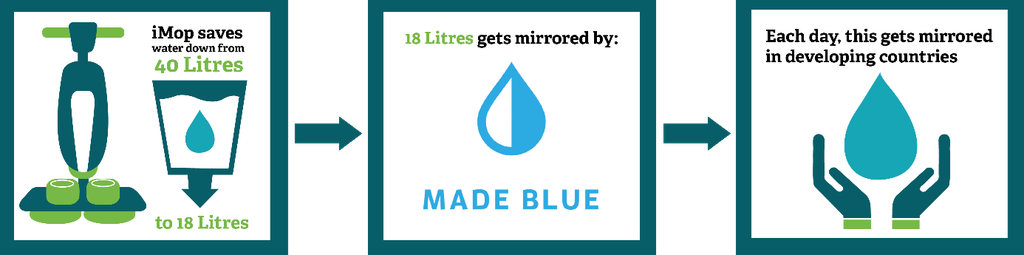
- Machines set up properly: Scrubber dryers and carpet machines have a wide range of water settings, and the default is rarely the lowest one that does the job. As an example, our i-Mop scrubber dryers use up to 70% less water than traditional mopping, cutting a typical clean from 40 litres to 18.
The water we save goes further than the building. Through our partnership with the Made Blue Foundation, every litre we save is matched by the same amount of clean drinking water donated to communities facing water scarcity. In 2024, that came to over 467,000 litres. We have also added water to the environmental aspects we manage under ISO 14001, with a Water Reduction Plan and annual targets. (Read more about this in our Impact Report 2024-25).
There’s also a planning point. With restrictions in place now and no guarantee that next year will be any wetter, some tasks may have to move. External washing and window cleaning are the obvious ones. Knowing in advance which tasks are affected, and agreeing what happens instead, is much easier than finding out the week a restriction applies.
Less carbon, cleaner buildings, no trade-off
The thing worth saying plainly is that almost none of this means cleaning less. Concentrated products, better dosing, microfibre, fewer deliveries and properly set machines all reduce carbon and water while cleaning to a higher standard. The exceptions are few, and they’re worth discussing openly rather than pretending they don’t exist.
Our purpose is to create clean, hygienic and safe environments for the people who use them to thrive in. After a summer like this one, that has to include the environment outside the building as well as the one inside it.
This work sits within a wider framework.
Our ESG Working Group has chosen four of the UN Sustainable Development Goals for Nviro to actively support:
- Quality Education (SDG 4)
- Clean Water and Sanitation (SDG 6)
- Decent Work and Economic Growth (SDG 8)
- Responsible Consumption and Production (SDG 12)
The water, product and fleet work above maps directly onto SDGs 6 and 12. It sits alongside our commitment to the Real Living Wage and to training and developing our colleagues.

Talk to us about your own reporting
If you’re pulling together a climate action plan, a carbon report or a tender response before the end of the year and you need figures from your cleaning provider, speak to your Head of Service if you already work with us, or email our ESG Manager, Tesh Patel at tpatel@nviro.co.uk.
We would rather give you data you can use than a statement of intent.
Our latest data will be published in our updated Impact Report in January 2027.
Find out more about Nviro’s ESG commitments.